For a long time now, “move fast and break things” was the operating philosophy of the innovation economy. Ship quickly, learn from failure, outpace the known competitor. Venture capital funded the burn. Founders wore the chaos as a badge of honor. It worked, inside a specific set of conditions that are fading and transforming.
What am I talking about?
AI has dissolved these premises. And the companies still running the old playbook are spending money they cannot afford to lose on a strategy built for a world that is going away quickly.
TL;DR: “Move fast and break things” was a rational strategy when your competitors were identifiable and building was expensive. AI has flattened the innovation economy, making product replication faster and cheaper than ever. In that environment, speed without discipline is not boldness. It is a liability. The new competitive edge belongs to companies that move fast and build things that last.
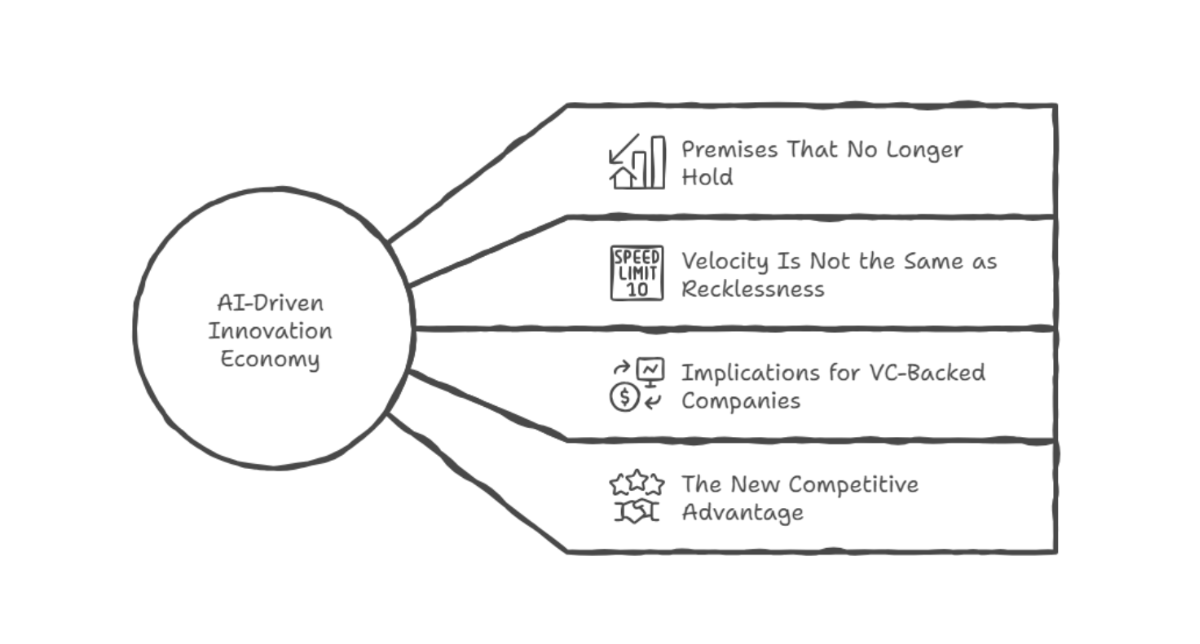
The Premises That No Longer Hold
The break-things philosophy rested on three structural advantages:
- First, building was expensive, so only well-capitalized teams could compete.
- Second, competitors were identifiable, giving you a known target to outpace.
- Third, customers were patient enough to tolerate broken experiences while you iterated toward something that worked.
The pace of innovation did change this before AI. Tools like N8N and Canva initiated the flattening of the innovation curve. But AI dismantles all three simultaneously.
Building is no longer expensive in the way it was. A focused team with strong AI leverage can build in weeks what previously required months and a Series A. I was recently presented a commercial contract management SaaS platform that was built in two days. It was a complete system that could be sold.
The capital barrier that protected funded startups from garage competitors has compressed dramatically. Your next competitor is not the well-funded startup across town. It is anyone, anywhere, with clarity of purpose and access to the same foundational models you are using.
The competitive field is no longer a defined arena. It is open water. You cannot outpace a competitor you cannot manage seeing coming, which means the sprint-and-recover model of breaking things and fixing them before the competition catches up no longer holds. By the time you are fixing what you broke, someone you have never heard of may already be in the market with something cleaner.
And customers, particularly enterprise buyers, have more options than at any prior point. Breaking things used to be forgivable because alternatives were limited. That tolerance will erode.
Velocity Is Not the Same as Recklessness
The reframe here is important because it is not an argument for slowing down. Speed still matters enormously. What has changed is what you do with speed.
Breaking things treats iteration as the primary learning mechanism. You ship, observe the failure, and rebuild. Each cycle produces information but also produces wreckage, and wreckage has costs that compound in ways the lean startup framework never fully accounted for.
Building things treats speed as accumulative. Every fast move adds to a foundation rather than requiring repair. The learning happens before the ship, not after, because AI makes pre-launch simulation, prototyping, and testing accessible at a fraction of the historical cost. You can learn what a full development cycle used to teach you without paying the full cost of the cycle. In other words, you might break things, but it happens inside your build process.
The best operators in this environment are not slow. They are precise. They move quickly inside a disciplined framework that uses AI to compress the research and validation loop, so that what ships is closer to right the first time. That is a fundamentally different operating posture than shipping recklessly and fixing later.
What This Means for VC-Backed Companies Specifically
The traditional venture model was built around funding the sprint. Burn fast, capture the category, harvest the return. The model assumed that category definition was achievable and that a well-funded team could establish a defensible position before competition arrived in force.
When your competition can come from anywhere, category capture becomes much harder to sustain. The moat you built over three funding rounds can be approached by a focused team with AI leverage in a fraction of the time. That changes the math on burn rate, on acceptable failure rate, and on what winning looks like before your next round.
The smarter VC-backed companies are using AI not just to build faster but to reduce the variance in their outcomes. Better research before building. Better simulation before launching. Better instrumentation before scaling. The goal is not to eliminate risk. It is to take smarter risks with better information, which means failing less, not failing faster.
The New Competitive Advantage
In a flattened innovation economy, the durable advantages are not technical. They are relational and reputational.
The company that builds deliberately, ships something that works, and earns genuine customer trust is in a structurally stronger position than the company that ships fast, breaks things, and asks customers to endure the repair cycle.
This has a direct implication for how companies should think about their most scarce resource in the AI era. It is not engineering capacity. It is not capital. It is customer attention and trust, which are finite, hard to earn, and easy to damage.
Which raises the question that the next article in this series will explore directly: if AI flattens product differentiation and makes replication trivially easy, what is the last moat that cannot be commoditized?
Semi-spoiler alert: It has nothing to do with technology.
FAQ
Isn’t speed still the primary advantage in competitive markets? Speed matters, but the type of speed has changed. Shipping fast into a market where your product will be replicated quickly is not an advantage if you have not built the customer relationships that create retention. Speed of trust-building now matters more than speed of shipping.
Does this apply to early-stage companies or only scaled ones? It applies most urgently to early-stage companies, because the customer relationships you build in your first hundred customers set the template for everything that follows. Breaking things early trains your market to expect unreliability at exactly the moment you need them to become believers.
How do you move fast and build things at the same time without slowing the organization down? The answer is front-loading the thinking. AI dramatically reduces the cost of research, simulation, and validation before development begins. The speed comes from compressing that pre-build phase, not from skipping it.
This article was originally published on cfoproanalytics.com titled “Move Fast and Build Things: How AI Is Rewriting the Rules of Innovation”

Connect with CFOPro+Analytics to explore how fractional CFO services can support smarter, principle-driven business decisions.
Salvatore Tirabassi is an accomplished leader and strategist with over 25 years of diverse industry experience. His expertise spans finance, accounting, analytics, credit risk, data science, and strategy.
Access your CFO Needs in 5-Minutes


