Focus comes from principles guiding to a vision. Success comes from execution guiding to an opportunity. This depends on teams aligned on core values.
Exceptional success relies on focus to create remarkable outcomes. But it does not work the other way around.
Think about it. This basic rubric may define the winner in the battle between Anthropic and OpenAI.
Focus grounded in principles is fundamentally a method of trust, community, and consistency. Great business leaders have the ability to discern and manage priorities while communicating these objectives to the teams working to achieve their vision.
Why does this matter?
Because execution guiding to an opportunity just works better when a team has alignment, and alignment comes from focus.
Now, you can have great execution guiding to an opportunity. That is a common process for all competitors in the same market. What sets the eventual winner apart, though, is focus based on principles guiding to a vision.
When we look at OpenAI and Anthropic, there is no question that both are executing at an extraordinary level. OpenAI has raised over $168 billion in total funding, including a staggering $110 billion round in February 2026 at an $840 billion valuation, but this is the largest private funding round in history. Anthropic has raised approximately $67 billion, including a $30 billion Series G in February 2026 at a $380 billion valuation, the second-largest venture deal ever. They are both going to spend that money to achieve dominant leadership in the AI marketplace.
But, the edge will go to the company that drives with focus, thereby leveraging a committed and aligned team and culture. Let’s unpack that.
TL;DR: Both OpenAI and Anthropic are executing at a generational scale. But the Pentagon episode of late February and early March 2026 revealed something more consequential than a contract dispute. It exposed a fundamental difference in how each company’s leadership communicates principles. That difference may matter more than compute or capital in determining who wins in a highly dynamic environment.
Two CEOs, Two Signals
I don’t know Sam Altman or Dario Amodei personally. Both are attempting extraordinary things. I am not arm-chair critiquing here.
But for the purposes of this post, I want to speak to some of the leadership signals they each put out, and how those signals affect the path to winning in this market. Signals of consistency, prioritization, and communication are what drive stronger teams and motivate the edges of a business to all move in one direction.
The Pentagon episode that unfolded over the last week of February 2026 made me think about these two companies and their CEOs in a totally different context.
Anthropic was in negotiations with the Department of Defense over a classified AI deployment contract. The company had drawn two hard lines: no use of its technology for mass surveillance of American citizens, and no autonomous weapons systems capable of striking targets without human oversight. When the Pentagon refused to accept contract language reflecting those principles, Anthropic walked away from the deal. The government designated Anthropic a “supply chain risk” and President Trump ordered federal agencies to cease using its technology.
Whatever you think of the underlying policy, and there are thoughtful arguments on multiple sides, the behavioral signal from Anthropic’s leadership was clear: these are our lines, and we hold them.
OpenAI’s response unfolded differently. Earlier in the week, Altman had publicly voiced support for Anthropic’s position, stating the two companies shared the same “red lines.”
Hours after Anthropic was blacklisted, OpenAI announced it had reached its own Pentagon deal, swooping into the breach. Critics erupted. OpenAI employees signed an open letter supporting Anthropic. Protesters gathered outside OpenAI’s San Francisco offices. ChatGPT saw a 295% spike in uninstalls. Claude surged to the #1 spot in Apple’s App Store.
These user responses, I think, drove the contrite OpenAI messaging that followed. But my point goes much deeper.
This is not about words and dollars. It’s about values.
By Monday, Altman acknowledged the damage himself, writing that the deal “looked opportunistic and sloppy” and that the company “shouldn’t have rushed to get this out.” He renegotiated the contract terms and added surveillance protections that were absent from the original agreement.
Again, I am not making a judgment about who made the correct strategic call on serving the U.S. government. That is genuinely complex. What I am pointing to is the pattern: articulate a principle, act in apparent contradiction to it, then backpedal and repair. That cycle has consequences that go well beyond a week of bad press.
It shows lack of focus. Principles not driving to the vision, and questions about core values. OpenAI employees, to be sure, are feeling this.
A Simple 2×2: Focus Drives Success, But Success Does Not Drive Focus
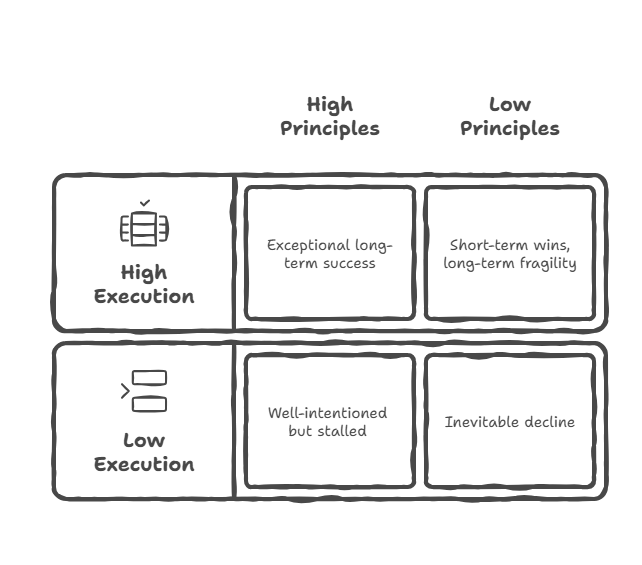
There is a concept in organizational behavior worth mapping here. Think of it as a simple 2×2:
| High Principles | Low Principles | |
| High Execution | Exceptional long-term success | Short-term wins, long-term fragility |
| Low Execution | Well-intentioned but stalled | Inevitable decline |
The upper-right quadrant, high execution with low principles, is where many great businesses live for extended periods. It can look like winning. Revenue grows. Deals close. Market share expands. But the organization is building on sand. When a moment of real pressure arrives, the absence of principled clarity causes the company to oscillate. Teams lose the thread. The edges of the business, the researchers, the engineers, the early customers who believed in the mission, start asking questions.
The upper-left quadrant is different. High execution grounded in high principles creates something that compounds over time: organizational trust. People inside and outside the company know what the organization stands for. They can predict how leadership will behave in hard moments. That predictability is not a constraint on growth. It is a force multiplier for it.
This is what Anthropic appears to be building. When the Pentagon delivered an ultimatum, Dario Amodei’s team held its position. The brand consequence was not punishment. It was reward. Claude went to #1 in the App Store organically, because consumers and professionals signaled that principle under pressure matters to them. That is a market signal worth far more than any individual government contract.
Anthropic employees are feeling this. They have purpose and are winning.
What Common-Sense Employees See Through
There is a line of thinking in some business circles that employees are primarily motivated by compensation and security, and that mission and culture are secondary. Anyone who has built or led a serious organization knows that this is wrong, at least for the employees who matter most.
The best people, the researchers, the safety engineers, the product designers who have real options, are watching how leadership behaves in moments like the Pentagon episode. When they see a CEO articulate a principle publicly on Thursday and sign a contract that appears to contradict it on Friday, something shifts. Not all at once. Not dramatically. But the calculation changes.
One OpenAI research scientist posted publicly: “I personally don’t think this deal was worth it.” Multiple employees told reporters the contract felt rushed and that the narrative had “become really painful.” This is not the signal of a team moving in one direction.
Compare that to the dynamic at Anthropic, where the company’s stance reportedly generated internal cohesion. The employees knew what the company stood for. They could defend it to their colleagues, to their families, to strangers on the internet. That clarity is enormously valuable and almost impossible to manufacture retroactively.
Not all business opportunities are created equal. Yes, the Pentagon money might be significant. Yes, the strategic positioning in classified AI systems could matter. But waffling publicly undermines your ethos in ways that compound invisibly, until they don’t
The Long Game
Both companies will raise more capital. Both will ship powerful models. Both will win major enterprise accounts. The race is not over, and I would not bet against either company on pure execution metrics.
But the question I keep coming back to is this: which company’s employees will still believe in what they’re building five years from now?
Execution without focus is a race to the middle. Any well-capitalized competitor can replicate a feature set or undercut on price. What cannot be easily replicated is an organization where the people doing the work understand the mission, believe leadership means what it says, and feel confident that the company will hold its ground when the pressure is real.
Anthropic’s handling of the Pentagon episode: walk away, absorb the short-term consequence, watch the market reward you. But, you can be assured that Dario’s team is more cohesive and motivated than Sam’s.
A year from now, when we look back at the first quarter of 2026, we may identify this week not as a regulatory footnote, but as the moment the two companies’ trajectories visibly diverged.
Focus begets success. Success does not beget focus. That asymmetry tends to matter most exactly when the stakes are highest.
Original article published on cfoproanalytics.com, titled:
Anthropic and Open AI: How Core Values May Be the Difference Maker in the Battle for #1

Connect with CFOProAnalytics to explore how fractional CFO services can support smarter, principle-driven business decisions.
Salvatore Tirabassi is an accomplished leader and strategist with over 25 years of diverse industry experience. His expertise spans finance, accounting, analytics, credit risk, data science, and strategy.


