How to Defend Your Valuation When “Anyone Can Build”
I recently had a conversation with a founder who was incredibly proud of a new feature his team had shipped in three weeks. It was elegant, solved a real pain point, and used a sophisticated implementation of a vector database. Ten minutes later, I showed him a demo of a seed-stage startup that had built the exact same functionality in forty-eight hours using an AI agent.
The look on his face said it all. We are living in the “Anyone Can Build” era.
If your pitch deck relies on a “unique feature set” as your primary moat, you aren’t just being optimistic—you’re being dangerous. In a world where AI has flattened the cost of software development, features are no longer assets; they are temporary advantages with a rapidly approaching expiration date.
For the strategic entrepreneur, the question isn’t how fast you can build, but how hard you are to replace.
TL;DR:
AI has made software features faster and cheaper to replicate, making feature-based competitive advantages increasingly fragile. To defend valuation, founders need stronger moats built around proprietary data, distribution and customer trust, and capital-efficient execution.
The CFO’s role is to ensure every dollar invested strengthens these durable advantages rather than funding features competitors can easily copy.
The Death of the Feature Moat
In the previous decade, code was a fortress. If you had 50 engineers working for two years, you had a head start that was difficult to overcome.
Today, that head start has shrunk from years to weeks. Growth equity investors and VCs have caught on. They are no longer paying premiums for “cool tools.” They are looking for durability.
That advantage has narrowed. AI-assisted development has reduced the time and cost required to build polished interfaces, automate workflows, connect APIs, and reproduce common product functionality. A feature can still create short-term differentiation, but it is increasingly dangerous to treat a feature set as the primary reason an investor should assign a premium valuation.
Investors are asking a harder question:
What remains valuable if another company can reproduce the product experience quickly?

What is a fundraising moat?
A fundraising moat is a measurable business advantage that makes a company harder to displace and gives investors confidence that future growth will not be competed away immediately. It is not one feature, patent, or clever technical implementation. It is the combination of assets and operating capabilities that improve retention, pricing power, distribution, data quality, or capital efficiency over time.
For a startup, a credible moat should answer three questions:
- What becomes stronger as the company serves more customers?
- Why would a customer stay rather than switch to a cheaper substitute?
- How does each dollar of investment increase the company’s long-term value?
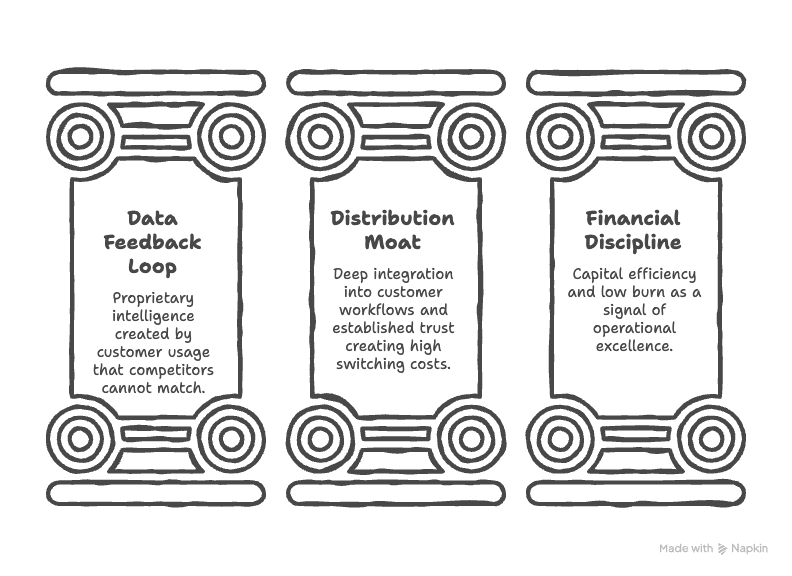
Three Pillars of the Fundraising Moat
If you want to defend a high valuation in your next round, you need to prove that your business has structural advantages that an LLM cannot replicate. As a Fractional CFO, I advise my clients to focus on three specific areas:
1. The Data Feedback Loop
Your software is just a container. The value is in the data it collects. If your product gets smarter, faster, or more efficient every time a customer uses it. and that “intelligence” is proprietary to you—you have a moat. Investors want to see that your data creates a “flywheel” where more usage leads to better outcomes that competitors cannot match even with the same code.
2. The Distribution Moat
I often tell founders: “First-rate distribution beats second-rate product every time.” In the AI era, this is even more true. If you own the relationship with the CFO or Head of Operations and are deeply integrated into their workflow, the “switching cost” is your moat. It’s not about the software; it’s about the trust and the friction of moving elsewhere.
3. Financial Discipline as a Strategy
This is where the CFO function becomes a competitive weapon. In a market where “Anyone Can Build,” capital is often wasted on redundant development. The founder who uses AI to keep their burn low while maintaining high output is the one who wins the valuation game. Capital efficiency is a signal of operational excellence that investors will always pay a premium for.
The CFO’s Role in Defensibility
Defensibility is no longer just a product conversation; it’s a P&L conversation. As we move into a more automated market, the CFO must be the one to ask the hard questions:
- What is the ROI on this feature if a competitor can replicate it in a weekend?
- Are we building a product, or are we building a data asset?
- How does our unit economics change if our “moat” is challenged by a zero-cost alternative?
The Bottom Line
The “Anyone Can Build” era isn’t a threat if you know where the real value lies.
Stop selling your features and start selling your durability. Investors aren’t looking for the fastest builder anymore; they are looking for the founder who has built a business that is too expensive, too integrated, and too data-rich to be disrupted by a prompt.
Your code is a commodity. Your customer relationships and your data are your fortress.
FAQs
- Are product features still a competitive advantage in the AI era? Features can create short-term differentiation, but AI makes them increasingly easy to replicate. Durable advantages come from proprietary data, customer relationships, distribution, and trust.
- How can a startup build a defensible moat? Focus on creating data feedback loops, building strong customer relationships and distribution channels, and integrating deeply into customer workflows. These advantages are much harder for competitors to copy.
- What role does a CFO play in building a fundraising moat? A CFO helps founders evaluate whether product investments create lasting value, improve unit economics, or simply add features competitors can replicate. Capital efficiency becomes a strategic advantage when building defensibility.
The article was originally published on CFOPro+Analytics, titled “The Fundraising Moat: How to Defend Your Valuation When Anyone Can Build”

Salvatore Tirabassi is the Founder of CFOPro+Analytics, providing fractional CFO services to growth-stage companies. Based in New York, he leverages over 24 years of experience in venture capital and strategic finance to help entrepreneurs master cash flow, unit economics, and equity value creation through data-driven financial clarity.
Assess your CFO needs in 5-minutes


